The One-Word Problem
When a clue-giver in Codenames says “forest, two,” the board lights up with trees, a bear, a cabin, and a picnic table. The guesser sees four words and assumes the clue-giver sees four words. They do not. The clue-giver sees a risk calculation, a probability curve, and a single word that barely holds the entire semantic structure together. The game is not about vocabulary. It is about the ambiguity tax that every one-word clue levies on the team’s shared understanding.
Codenames is the party game that most players misunderstand. They think it rewards a large vocabulary, or perhaps a clever mind. In reality, it rewards the ability to manage semantic noise. The clue-giver is not trying to be clever. They are trying to minimize the probability that the guesser will pick a target word that belongs to a neutral card, a hit, or a dead assassin. Every clue is a negotiation between clarity and risk, and the ambiguity tax is the cost of that negotiation.
How the Tax Works
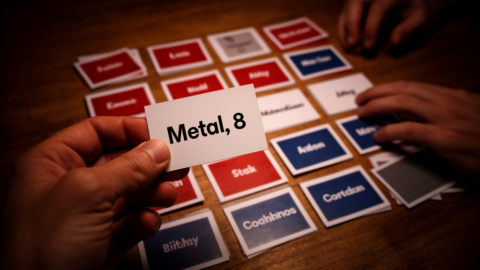
Consider the board layout: 25 words arranged in a 5×5 grid. The clue-giver selects a word and a number. The guesser then names words from the board, hoping to match the color of their team. The clue-giver’s goal is to guide the guesser to their team’s words without leading them to the assassin, neutral cards, or the opposing team’s words.
Here is where the tax enters. A single word clue is a broad brush. It captures a cluster of related concepts, but it also captures unrelated concepts that happen to share a semantic neighbor. When the clue-giver says “ocean, three,” they are betting that the guesser will find three words related to the ocean. But what if one of those words is also related to “depth,” which is also related to a neutral card? The guesser might pick it, triggering the tax. The clue-giver loses a turn, or worse, hands the initiative to the opposing team.
This is not a failure of vocabulary. It is a failure of precision. The single-word constraint forces the clue-giver to use a word that is semantically broad enough to cover multiple targets, but narrow enough to avoid false positives. This is a narrow path. Most clues fail because the clue-giver cannot find a word that sits exactly in that sweet spot.
The Psychology of the Guess
The guesser is not just looking for the word. They are looking for the clue-giver’s intent. They are trying to reverse-engineer the clue-giver’s mind. This is where the game becomes a psychological duel. The guesser must ask: what word would my partner use to describe these three cards? What semantic field are they thinking in? Is it literal? Is it metaphorical? Is it a pun?
Research in cognitive linguistics shows that human language is inherently ambiguous. Words do not have fixed meanings; they have clusters of associations that vary from person to person. When the clue-giver says “light, two,” they might mean illumination, weight, or importance. The guesser must guess which one. This is the ambiguity tax. It is the cost of using a single word to describe a complex set of associations.
The guesser’s job is to minimize this tax. They must pick words that are most likely to be the target, while avoiding words that are likely to be false positives. This requires a deep understanding of the board, the clue-giver’s style, and the semantic landscape of the language. It is a skill that takes practice to develop, and it is the difference between winning and losing.
Strategies to Reduce the Tax
There are two main strategies to reduce the ambiguity tax: cross-referencing and semantic clustering.
Cross-referencing involves looking at the board and identifying words that share a semantic neighbor with the target words. If the clue-giver says “forest, two,” the guesser might look for words related to “trees,” “woods,” “nature,” or “green.” They might also look for words related to “dark,” “shadows,” or “wild.” By cross-referencing, the guesser can narrow down the possible meanings of the clue and reduce the risk of picking a false positive.
Semantic clustering involves grouping words on the board into semantic categories. If the board contains “apple,” “banana,” “cherry,” and “dog,” the guesser might group “apple,” “banana,” and “cherry” as fruits, and “dog” as an animal. When the clue-giver says “fruit, three,” the guesser knows exactly which words to pick. This strategy requires the guesser to have a strong mental map of the board and the ability to quickly identify semantic categories.
Both strategies require the guesser to think like the clue-giver. They must anticipate the clue-giver’s thought process and predict the words they will use. This is a skill that takes practice to develop, and it is the key to mastering Codenames.
The Role of the Clue-Giver
The clue-giver’s job is to find a word that is semantically broad enough to cover multiple targets, but narrow enough to avoid false positives. This is a difficult task. It requires the clue-giver to have a deep understanding of the language and the ability to think abstractly. They must be able to see the board as a semantic landscape and find the words that sit in the sweet spots.
One effective strategy for the clue-giver is to use abstract words. Abstract words like “energy,” “time,” or “color” can cover a wide range of concrete words. For example, the clue “energy, two” might cover “lightning,” “power,” “spark,” or “electric.” This strategy reduces the ambiguity tax by covering multiple targets with a single word. However, it also increases the risk of picking a false positive. The clue-giver must balance the breadth of the word with the risk of hitting a neutral card or the assassin.
Another strategy is to use concrete words. Concrete words like “ocean,” “mountain,” or “fire” are more specific and reduce the risk of false positives. However, they also cover fewer targets, which means the clue-giver must use more clues to cover all the targets. This strategy requires the clue-giver to be precise and to carefully select words that cover the maximum number of targets without hitting a false positive.
Why This Matters
Codenames is often dismissed as a simple party game. It is not. It is a complex semantic puzzle that rewards players who understand the ambiguity tax and know how to manage it. It is about precision, psychology, and the ability to think abstractly. Players who master these skills will find that Codenames is one of the most rewarding party games they will ever play.
The ambiguity tax is the hidden cost of the game. It is the reason why teams fail and why games are lost. By understanding the tax and learning how to reduce it, players can transform their gameplay from a guessing game into a strategic contest. This is the secret to mastering Codenames.
Sources & Further Reading
- Cognitive Linguistics: An Introduction — Wikipedia
- Metaphors We Live By — University of Chicago Press
Photo by Fox & Hyde on Unsplash.