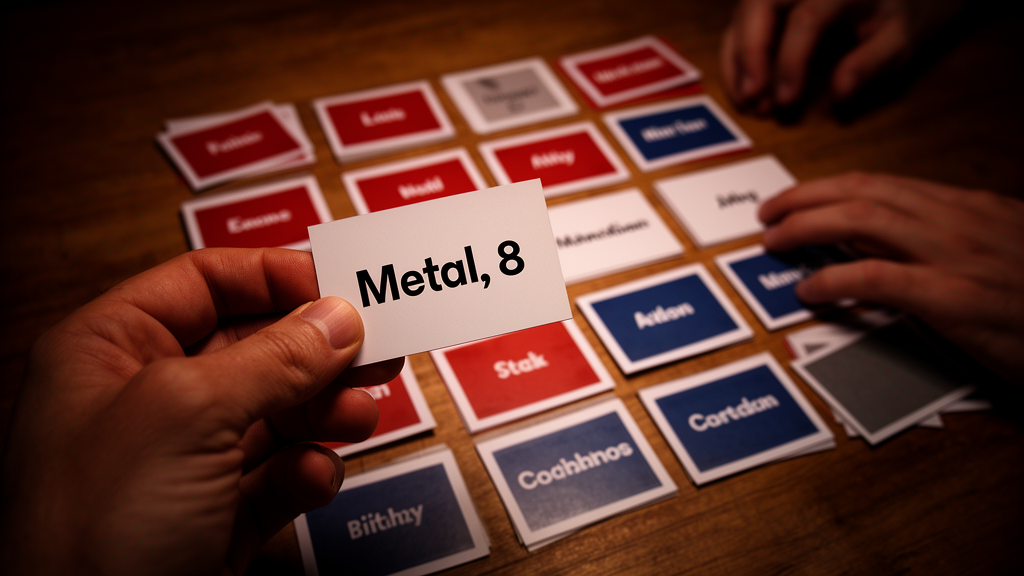
Most players assume Codenames is a game about vocabulary. They sit down with a grid of twenty-five face-down cards, a partner, and a shared lexicon, and they think the challenge is finding the right synonym. The game is not about finding the right word. It is about lying with perfect precision. The entire game collapses if the clue-giver tells the truth, because telling the truth gives the opposing team exactly what they need to win. The mechanic that makes this work is not the grid. It is the one-word constraint.
When you play Codenames, you are playing a game of information asymmetry disguised as a word association puzzle. The clue-giver holds the map to the board, but they are only allowed to speak in a single word and a number. They cannot say “Red card, two.” They cannot say “Apple, two, because it is red.” They must say “Fruit, two.” And in doing so, they must walk the razor’s edge between giving their team enough information to find their targets and giving the enemy team enough context to steal the win.
This is why Codenames is one of the most psychologically demanding party games ever designed. It forces two people to coordinate their thinking without actually communicating. It requires the clue-giver to lie to their own team to protect the game, while simultaneously telling the truth to the enemy team to mislead them. The one-word constraint is not a limitation. It is the entire game.
The Geometry of a Single Word
Let us look at a specific board. The words are: Bank, River, Bridge, Water, Glass, Ocean, Wine, Paper, Knife, Shield, Fire, Ice, Mountain, Desert, Forest, Tiger, Lion, Cat, Dog, Bird, Eagle, Hawk, Falcon, Parrot, Penguin. Your team controls Bank, Bridge, Wine, Knife, Mountain, Tiger, Eagle, and Parrot. The enemy team controls River, Water, Glass, Ocean, Paper, Shield, Fire, Ice, Desert, Forest, Lion, Cat, Dog, Bird, Hawk, and Falcon.
You have eight words to cover. You can give a maximum of eight words in a clue. If you say “Water, eight,” you have just handed the enemy team River, Water, Glass, Ocean, Paper, Shield, Fire, and Ice. You have lost the game in one turn.
If you say “Nature, eight,” you have given them Mountain, Desert, Forest, Tiger, Lion, Cat, Dog, and Bird.
If you say “Metal, eight,” you have given them Knife, Shield, Fire, Ice, Mountain, Desert, Forest, and Tiger.
The clue-giver must find a word that connects to their own team’s words while excluding the enemy’s words. They must find a word that is true to their team but false to the enemy. In this specific board, the only viable clue is “Metal, eight” if they want to risk it, but that gives the enemy Knife, Shield, Fire, Ice, Mountain, Desert, Forest, and Tiger. Wait, that is terrible. What about “Sharp, eight”? That gives Knife, Bridge, Eagle, Parrot, Tiger, Lion, Cat, Dog. That is also terrible.
The clue-giver must lie. They must find a word that connects to some of their team’s words but not all, and hope that their team can figure out the pattern. They might say “Sharp, four.” This connects to Knife, Bridge, Eagle, and Parrot. It excludes River, Water, Glass, Ocean, Wine, Paper, Shield, Fire, Ice, Mountain, Desert, Forest, Tiger, Lion, Cat, Dog, Bird, Hawk, and Falcon. The clue-giver has just lied to their team. They said “Sharp,” but Bridge is not sharp. Eagle is not sharp. Parrot is not sharp. They are relying on their team to understand that “Sharp” is a metaphor for the shape of the cards, or the function of the knife, or the metaphorical sharpness of an eagle’s dive.
This is the core tension of the game. The clue-giver is not describing the cards. They are describing the relationship between the cards. And because they are limited to one word, they must find a relationship that is broad enough to cover their targets but narrow enough to exclude the enemy. This is why Codenames is not a word game. It is a logic puzzle wrapped in a vocabulary test.
The Psychology of the Clue-Giver
The clue-giver in Codenames is under immense pressure. They are the only person who sees the entire board. They know exactly which cards are safe and which are dangerous. They must construct a clue that their team will understand, while ensuring that the enemy team does not. This requires a deep understanding of their team’s thought processes. It requires them to think like their team, while simultaneously thinking like the enemy.
This is why experienced clue-givers develop a style. Some are literal. They give clues like “Animal, four” for Tiger, Lion, Cat, and Dog. They rely on their team to pick up on the obvious connections. Some are abstract. They give clues like “Sharp, four” for Knife, Bridge, Eagle, and Parrot, relying on their team to understand the metaphorical connection. Some are risky. They give clues like “Metal, eight” for Knife, Shield, Fire, Ice, Mountain, Desert, Forest, and Tiger, hoping that their team can pick out the four they need from the eight.
The riskiest clues are the most rewarding. If a clue-giver says “Metal, eight” and their team picks up Knife, Shield, Fire, Ice, Mountain, Desert, Forest, and Tiger, they have won the game. But if they pick up one of the enemy’s cards, they have lost the game. This is why the one-word constraint is so important. It forces the clue-giver to take risks. It forces them to trust their team. It forces them to lie.
The enemy team, meanwhile, is trying to figure out what the clue-giver is thinking. They are trying to reverse-engineer the clue. They are trying to figure out which cards the clue-giver is trying to protect. This is why the enemy team must be careful. They must not pick up a card that belongs to the clue-giver’s team. They must pick up a card that belongs to the enemy team, or skip a turn entirely.
This is the psychological dance of Codenames. The clue-giver is trying to guide their team without giving away the game. The enemy team is trying to figure out what the clue-giver is thinking without giving away the game. It is a game of information warfare, fought with words.
Why the One-Word Constraint Works
The one-word constraint is not arbitrary. It is a design choice that forces the game to be about logic, not vocabulary. If the clue-giver could use multiple words, they could simply say “Bank, Bridge, Wine, Knife.” They could describe the cards directly. They could give the game away. The one-word constraint forces them to find a relationship between the cards. It forces them to think abstractly.
This is why Codenames is so popular. It is accessible to anyone who can read. It is challenging for anyone who wants to think deeply. It is social, because it requires teamwork. It is strategic, because it requires careful planning. It is psychological, because it requires understanding your opponents.
The one-word constraint is the key to all of this. It is the mechanic that makes the game work.
How to Play the Enemy
When you are playing the enemy team in Codenames, your goal is to figure out what the clue-giver is thinking.
This requires you to think like the clue-giver. You must ask yourself: “What word would I use to connect these cards? What relationship do they share? What metaphor could I use to describe them?” You must try to put yourself in the clue-giver’s shoes. You must try to understand their thought processes.
They must not rush to pick up a card. They must think carefully. They must try to figure out what the clue-giver is thinking.
This is the strategy of the enemy team in Codenames. It is the strategy of the player who wants to win. It is the strategy of the player who understands that the game is not about words. It is about logic. It is about psychology.
Common Mistakes New Players Make
New players often make the mistake of thinking that Codenames is a game about vocabulary. They think that the clue-giver should give clues that are directly related to the cards. They think that the clue-giver should say “Bank, Bridge, Wine, Knife.” They think that the clue-giver should describe the cards directly. They think that the game is about finding the right word.
This is wrong. The game is about finding the right relationship. The game is about finding the right lie. The game is about finding the right word that connects to the cards but excludes the enemy.
New players also make the mistake of thinking that the clue-giver should give clues that are safe. They think that the clue-giver should give clues that are unlikely to hit the enemy team. They think that the clue-giver should give clues like “Animal, four” for Tiger, Lion, Cat, and Dog. They think that the clue-giver should avoid risk.
This is wrong. The game is about taking risks. The game is about giving clues that are likely to hit the enemy team, but hoping that the team can pick out the cards they need. The game is about trusting the team. The game is about lying.
Advanced Clue-Giving Techniques
Experienced clue-givers use a variety of techniques to give clues that are effective but risky. They use metaphors. They use abstract concepts. They use puns. They use wordplay. They use cultural references. They use inside jokes. They use anything that their team can understand, but the enemy team cannot.
They also use the concept of “skipping.” They give a clue that connects to some of their team’s cards, but not all. They hope that their team can pick out the cards they need, and skip the ones they do not. They hope that the enemy team will not pick up any of the cards they need. They hope that the enemy team will skip a turn, or pick up a card that belongs to the enemy team.
This is the advanced strategy of Codenames.
Why Codenames Endures
Codenames was designed by Vlaada Chvátil and published by Czech Games Edition in 2015. It won the Spiel des Jahres in 2015, the highest honor in the board game industry. It has sold millions of copies worldwide. It has become one of the most popular party games of all time.
It endures because it is simple. It is easy to learn. It is easy to play. It is easy to teach.
It endures because it is fun. It is fun to play with friends. It is fun to play with family. It is fun to play with strangers. It is fun to play with anyone who wants to have a good time. It is fun to play because it is a game of words. It is a game of logic. It is a game of psychology.
It is the mechanic that makes Codenames one of the best party games ever designed.
FAQ
What is the best strategy for the clue-giver?
The best strategy is to find a word that connects to your team’s cards but excludes the enemy’s cards. You must take risks. You must trust your team. You must lie.
How do I know when to skip a turn?
You skip a turn when you cannot find a word that connects to your team’s cards without hitting the enemy’s cards. You must be patient. You must think carefully.
Is Codenames a game of luck or skill?
Codenames is a game of skill. Luck plays a small role, but skill determines the winner.
Can I use proper nouns in my clues?
You can use proper nouns, but you must be careful. You must ensure that the proper noun does not connect to the enemy’s cards. You must ensure that your team understands the reference.
What is the maximum number of words I can give in a clue?
You must ensure that the clue does not hit the enemy’s cards. You must ensure that your team can pick out the cards they need.
Sources & Further Reading
- Codenames (Board Game) — Wikipedia
- Spiel des Jahres 2015: Codenames — Spiel des Jahres