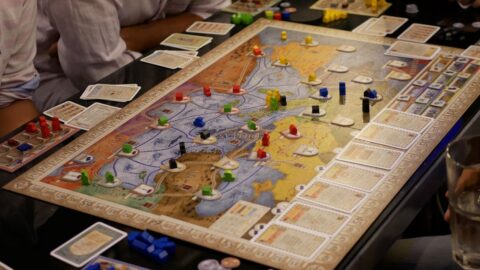

You are playing Catan. It is turn four. The player to your left has three settlements and is hoarding brick and wood. The player to your right has a port and is sitting on a mountain of ore and grain. You have a 6 and an 8, but you need a 5 and a 9, and the dice have been kind to nobody. You sit there, watching the board fill up, realizing that the game has stopped being about building and started being about begging. The trading phase, which was supposed to be the heart of the experience, has calcified into a series of silent, frustrating rejections. You are not playing a game anymore. You are playing a waiting room.
This is the Monopoly Problem. It is the single most common failure mode of modern board game design, and it is the reason why so many groups abandon the hobby after their first few sessions. When a game relies on player-to-player negotiation, but the rules do not force interaction, the table goes quiet. Players stop talking. They hoard resources. They wait for the dice to save them. The result is a game that feels like a math puzzle disguised as a social contract, and it is why the original Catan feels so hollow after the third play.
The good news is that the last decade of board game design has produced four excellent alternatives that keep the trading alive, even when the dice are not rolling your way. These games do not rely on the fragile hope that your opponent will be generous. They build the interaction into the core mechanics, ensuring that negotiation is not an optional extra, but the primary engine of victory. If you want to play a game that feels like Catan but actually delivers on its social promise, these are the four titles you should be putting on your shelf.
Why Catan’s Trading Phase Fails
To understand why these alternatives work, you first have to understand why the original breaks. In Catan, trading is a side door. It is not the house. You build settlements to generate resources. You trade resources to build settlements. The trading phase exists to lubricate the engine, not to drive it. When the dice are rolling hot, you rarely need to talk to anyone. When the dice are cold, you are forced to talk to everyone, but you have no leverage.
This creates a dynamic where the strongest players ignore the trading phase entirely, and the weakest players are forced to beg for scraps. It creates a ‘Monopoly Problem’ because the game does not force you to interact with your opponents’ weaknesses. You can build your engine in isolation, and if you are lucky, you win. If you are unlucky, you sit at the table, watching other people build, unable to force a trade that helps you. The game assumes that players will naturally find the most efficient trades. In reality, players hoard resources until the last possible second, and by then, it is too late.
The solution is not to remove trading. The solution is to make trading the primary mechanic, so that you cannot win without interacting with your opponents. The four games below do exactly that. They replace the fragile hope of Catan with systems that force engagement, regardless of the dice rolls.
1. The Princes of Florence: The Auction That Forces Interaction
If you want a game that replaces Catan’s passive trading with active, high-stakes negotiation, The Princes of Florence is the answer. It is a renaissance-themed engine builder where you do not trade resources directly. Instead, you trade opportunities. Every turn, players bid on the right to place their workers on the most valuable spaces on the board. The currency is not wood or brick. It is the ability to deny your opponent the space they need to build their engine.
This is the antidote to the Monopoly Problem because you cannot hoard your way to victory. You must actively engage with your opponents to secure the resources you need. If you ignore the auction, you lose access to the most powerful spaces. If you overpay, you starve yourself later. The game forces you to read your opponents, predict their needs, and bid accordingly. It turns the silent, frustrating trading phase of Catan into a dynamic, high-stakes auction that keeps every player engaged until the very end.
The beauty of The Princes of Florence is that it scales perfectly. At two players, it is a tense, back-and-forth battle for control. At four players, it is a chaotic, hilarious mess of broken alliances and last-minute snipes. It captures the core desire of Catan, building an engine and managing resources, but it does so by forcing you to interact with your opponents, rather than ignoring them.
2. Puerto Rico: The Role Selection That Eliminates Hoarding
Puerto Rico is often misunderstood as a worker placement game. It is not. It is a role selection game that forces interaction through a shared pool of actions. Each turn, one player selects a role, Builder, Captain, Mayor, Producer, or Market, and all players execute that role simultaneously. The key mechanic is the ‘Captain’ role, which allows you to ship goods to the market, but also allows you to steal a worker from your opponent if they have one on the Boardwalk.
This eliminates the Monopoly Problem by making every action a potential threat. You cannot simply build your own engine in isolation, because your opponent can choose a role that disrupts your plans. If you are hoarding corn, your opponent can choose the Producer role to force you to process it, or the Captain role to steal your worker. The game forces you to constantly adapt to your opponents’ choices, rather than waiting for the dice to save you.
Puerto Rico is a masterclass in forced interaction. It does not rely on the fragile hope of negotiation. It relies on the certainty that your opponent will try to disrupt your plans. It is a game that rewards foresight, adaptation, and the ability to read your opponents. If you want a game that feels like Catan but plays like a chess match, Puerto Rico is the answer.
3. 7 Wonders: The Card Drafting That Makes Trading Inevitable
7 Wonders replaces the chaotic, unpredictable trading phase of Catan with a structured, deterministic card drafting system. Each turn, players receive a hand of cards, select one, and pass the rest to the next player. The goal is to build a civilization by playing cards from your hand, but you are limited by the resources generated by your buildings.
This creates a unique form of interaction. You do not trade resources directly. You trade cards. If you need a specific resource, you can draft a card that provides it. If your opponent needs a card you have, you can pass it to them. The game forces you to constantly adapt to your opponents’ needs, because you know exactly what cards they have and what cards they are passing.
7 Wonders is the perfect solution for groups that want the social interaction of Catan without the frustration of the trading phase. It is also a game that scales perfectly, from two players to seven.
4. Splendor: The Chip Economy That Simplifies Trading
Splendor is often dismissed as a ‘light’ game, but it is one of the most elegant designs in the hobby. It replaces the complex resource management of Catan with a simple chip economy. Players collect colored chips to purchase development cards, which generate more chips. The goal is to reach 15 victory points.
The genius of Splendor is that it simplifies trading without removing it. You trade chips. If you need a specific color, you can take chips from the bank, or you can trade with your opponents.
Unlike Catan, where trading can stall the game for ten minutes, Splendor’s trading is fast and frictionless. You can trade three chips of one color for one chip of another, or trade two chips for one. The bank always has stock, so you never sit idle. The game forces you to plan ahead, because you know exactly what chips your opponents need to complete their sets. It is a game of quick decisions and constant adaptation, rather than long, drawn-out negotiations.
How to Choose the Right Game for Your Table
Choosing the right game depends on your group’s preferences. If you want a game that forces interaction through high-stakes bidding, choose The Princes of Florence. If you want a game that forces interaction through shared roles, choose Puerto Rico. If you want a game that forces interaction through card drafting, choose 7 Wonders. If you want a game that simplifies trading without removing it, choose Splendor.
They are the four games you should be putting on your shelf if you want to play a game that feels like Catan but actually delivers on its social promise.
The Monopoly Problem is not a flaw in the hobby. It is a challenge that the hobby has solved. These four games are the solution. They prove that you do not have to choose between a great engine and great interaction. You can have both. You just have to play the right game.
Sources & Further Reading
- Catan: Rules of Play — Catan Studio
- The Princes of Florence: Rules — Stronghold Games
- Puerto Rico: Rules of Play — Relic Games
- 7 Wonders: Rules — Relic Games
- Splendor: Rules — Relic Games