
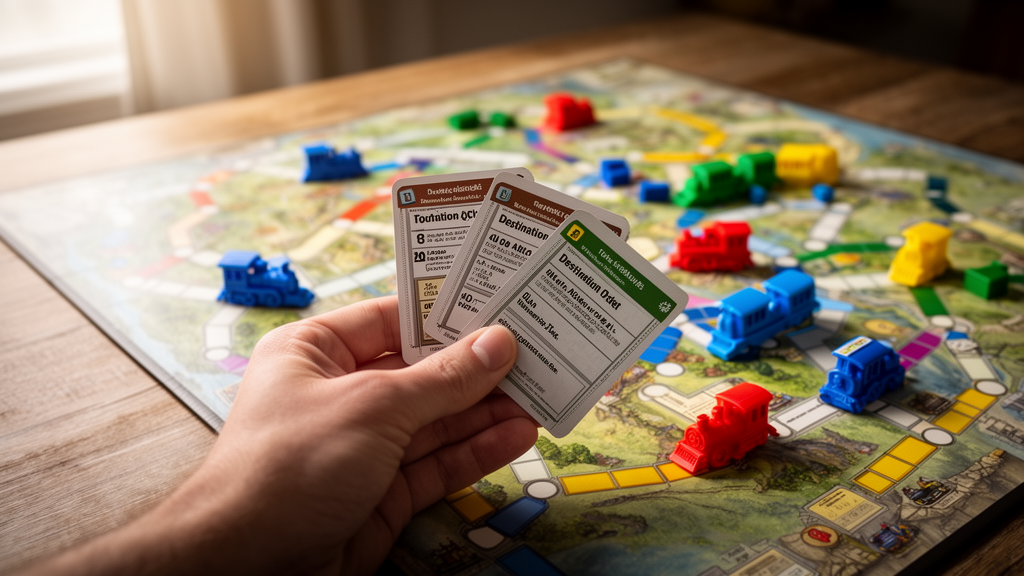
Most players spend their first dozen games of Ticket to Ride building a beautiful, useless network. They grab colorful plastic trains, connect cities, and feel productive. Then they look at their score sheet and realize they spent forty minutes connecting nothing they were paid to connect. The game ends, they lose, and they blame the dice or their opponent’s “aggressive” blocking. They are not losing because of bad luck. They are losing because they treated a spatial puzzle like a construction project.
The core error in Ticket to Ride is the assumption that the board state is the game. It is not. The board state is just the canvas. The game is the hidden contract between your hand of destination tickets and the physical space you claim. When you play Ticket to Ride, you are not trying to build the most connected network. You are trying to fulfill specific, often conflicting, spatial obligations while preventing your opponents from fulfilling theirs. The route that wins before the board is set is the one you plan in your head during the first three turns, before you place a single train car.
The Ticket Paradox: Why Connectivity Is a Trap
Every new player approaches Ticket to Ride with a logical instinct: build a dense, interconnected network. If you have trains in Chicago, you should connect them to St. Louis, then to New Orleans, then to Atlanta. This creates a robust web. It looks good. It feels safe. But in Ticket to Ride, a dense network is often a liability. Why? Because dense networks are expensive to maintain and easy to block.
Consider the classic cross-country route: Seattle to New York. It requires roughly 18 trains. If you build a dense web across the Midwest, you might spend 30 trains to connect ten cities. You have spent 12 extra trains on “connectivity” that yields zero points. Those 12 trains cost you 60 coins. In a game where the average score is 110 to 130 points, you have just set yourself back 15% of your potential score before you even drew your next ticket.
The winning strategy ignores connectivity. It embraces sparsity. The best routes in Ticket to Ride are long, direct, and often single-threaded. They do not branch. They do not loop. They go from point A to point B with the minimum number of trains required. This is counter-intuitive because we are trained to value redundancy. In real life, redundant roads are good. In Ticket to Ride, redundancy is bankruptcy. The player who wins is the one who builds the fewest trains to fulfill the most tickets.
This is why the opening ticket grab is so critical. Most players grab tickets that are close together, or tickets that fit into a natural geographic cluster. This is safe, but it is also low-yield. The high-yield tickets are the ones that span the map: Vancouver to Halifax, Seattle to New York, Denver to Atlanta. These tickets are hard to complete. They require crossing hostile territory. They require anticipating where your opponents will block. But when completed, they are worth 10, 12, or even 18 points. A single completed cross-country ticket is worth more than five small regional connections. The strategy is not to build more. It is to build less, but build it where it counts.
Reading the Map: The First Three Turns Decide the Game
The game is won or lost in the first three turns. This is not hyperbole. By turn three, the board has a specific topology. Certain routes are still open. Certain cities are still accessible. Once a route is blocked, the cost to bypass it increases exponentially. This is the concept of “blocking cost.” If you want to build a route through Chicago, and your opponent has already placed two trains there, you now have to go around. Going around might require 4 extra trains. Those 4 trains cost 20 coins. That is the price of being late to the table.
So, what do you do in the first three turns? You do not place trains on the board. You place tickets. You look at your hand of destination tickets and you identify the “anchor” routes. An anchor route is a long, high-value ticket that is still physically possible to complete given the current board state. If you see a ticket that goes from Montreal to New Orleans, and the path through Pittsburgh and St. Louis is still open, that is your anchor. You hold that ticket. You do not try to complete it immediately. You use it as a compass.
While you hold that ticket, you build the infrastructure that supports it. You might not build the full route. You might build the first four trains into Pittsburgh. You might build the last four trains out of New Orleans. You are not trying to connect them yet. You are trying to claim the endpoints. This forces your opponents to react. If they try to block you, they have to spend trains on a route that does not yet exist. If they ignore you, you will complete it. This is the “threat of completion.” It is more powerful than completion itself.
Most players fail to use this threat. They rush to connect cities because they feel the pressure of the timer or the boredom of waiting. But the player who wins is the one who sits on their trains. They wait. They watch. They let their opponents overextend. When an opponent builds a weak, fragmented network, they are vulnerable. They have spent trains on low-value connections. They have no long routes. They have no points. And now, you can swoop in and complete your anchor route, stealing the points they should have had.
The Blocking Game: How to Deny Without Committing
Blocking is the most misunderstood mechanic in Ticket to Ride. Most players think blocking means placing a train on a route to stop someone else. This is true, but it is also extremely expensive. If you place a train to block, you have spent resources. You have not gained points. You have not advanced your own game. You have only hindered another player’s. This is a net loss unless the other player was about to complete a route that would have won the game.
The winning blocker does not place trains on the board. They place tickets in their hand. By holding a high-value ticket that requires a specific route, they create a “phantom threat.” If you see your opponent holding a ticket that goes from Seattle to New York, you know they will eventually try to build that route. You do not need to block it immediately. You just need to make it expensive for them to do so. You can build a short, cheap route that intersects their path. You can claim a city that is a key hub. You do not need to stop them. You just need to make them pay more than they are worth.
This is the “cost of denial.” If your opponent wants to build a route through Chicago, and you have already claimed the route into Chicago, they have to go around. Going around costs them trains. Trains cost coins. Coins cost tickets. Tickets cost turns. By the time they complete their route, they have spent three extra turns and 15 extra coins. That is a net loss of 30 points. If their route was only worth 12 points, they have just lost the game by trying to complete it. This is why blocking is not about stopping people. It is about making their success too expensive to justify.
The key is to block lightly. Do not spend 4 trains to block a 12-point route. Spend 1 or 2 trains to make them go around. Make them pay the “detour tax.” This is the difference between a good player and a great player. A good player blocks aggressively. A great player blocks economically.
Endgame Timing: When to Scoop and When to Stay
The endgame in Ticket to Ride is not triggered by a timer. It is triggered by a player declaring “I am done.” This is a strategic decision that most players make too early. They see they have a few points, they see the board is getting crowded, and they declare “I am done.” This is a mistake. The endgame is not about having the most points. It is about having the most points relative to your opponents’ remaining potential.
When you declare “I am done,” you reveal your hand of destination tickets. If you have uncompleted tickets, you lose points. These points are subtracted from your total. This is the “penalty of exposure.” If you have a ticket that goes from Vancouver to Halifax, and you declare “I am done” before completing it, you lose 10 points. That is a catastrophic loss. It can turn a winning game into a losing one.
So, when should you declare “I am done”? You should declare it when you have completed all your tickets, or when the penalty of completing your remaining tickets is less than the points your opponents will gain by continuing to play. This is the “endgame threshold.” If you have 100 points, and your opponent has 90 points, and your opponent has one ticket left that is worth 12 points, you should not declare “I am done” unless you are sure they cannot complete it. If they can complete it, they will have 102 points. You will have 100. You will lose.
The winning endgame player does not rush. They wait. They watch their opponents. They let their opponents make mistakes. And when they see that their opponents are vulnerable, they declare “I am done.” This is the “scoop.” It is a strategic withdrawal. It is a calculation. It is the moment when the game shifts from a spatial puzzle to a mathematical one.
This is why the first three turns are so important. If you have built a sparse, efficient network, you will have more trains left in your hand. You will have more coins left in your bank. You will have more options. You will have more flexibility. You will be able to wait. You will be able to scoop. And you will win.
The Real Game: Spatial Awareness Over Construction
Ticket to Ride is often criticized for being too simple, for being too luck-based, for being too easy to learn. These criticisms miss the point. Ticket to Ride is not a game about complexity. It is a game about clarity. It is a game about seeing the map clearly, understanding the value of space, and making decisions based on that understanding. It is a game about spatial awareness.
Most players play Ticket to Ride as a construction game. They focus on the trains, the colors, the board state. They ignore the tickets. They ignore the points. They ignore the endgame. They build beautiful, useless networks. They lose. The player who wins is the one who plays Ticket to Ride as a spatial puzzle. They focus on the tickets, the points, the endgame. They ignore the trains. They ignore the colors. They ignore the board state. They build sparse, efficient networks. They win.
This is the lesson of Ticket to Ride. It is about building less. It is about connecting right. It is about playing the tickets. It is about understanding that the route that wins before the board is set is the one you plan in your head, before you place a single train car. It is about realizing that the game is not about the trains. It is about the space between them.
When you sit down to play Ticket to Ride, do not grab the trains. Grab the tickets. Look at the map. Find the anchor routes. Build the infrastructure. Block lightly. Wait for the endgame. Scoop when the math works. And remember: the game is not about the trains. It is about the space. It is about the route that wins before the board is set.
If you want to deepen your understanding of how gateway games balance accessibility with genuine strategic depth, Ticket to Ride Is Not a Strategy Game (And Why That’s the Point) offers a complementary look at why the game’s lack of complex mechanics is precisely what allows this spatial tension to emerge naturally.