
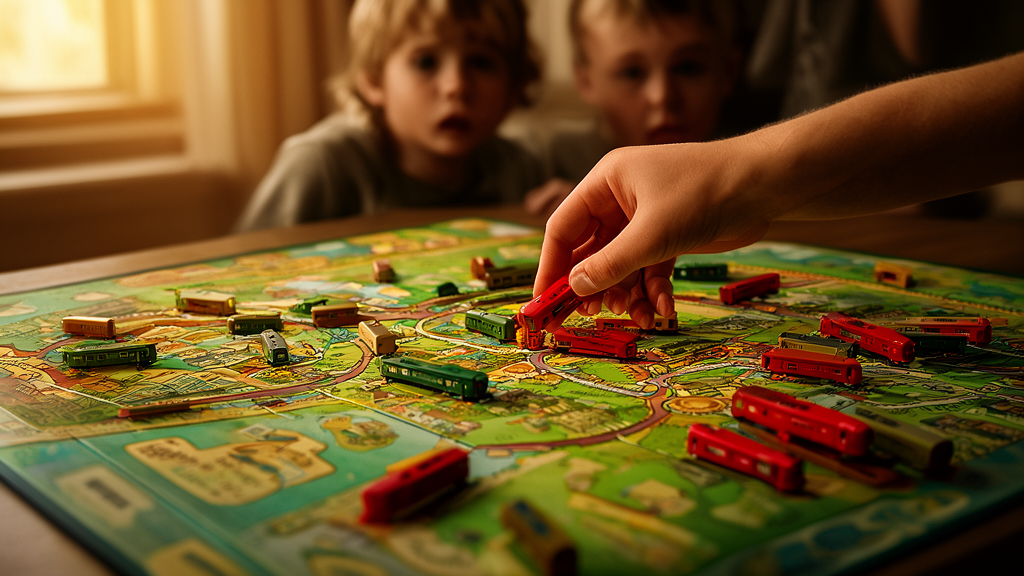
Stop trying to win Ticket to Ride. If you’re approaching the game like a worker-placement euro, you’re missing the entire design. Ticket to Ride isn’t about strategy. It’s about the social contract of a family game night, and its mechanics are specifically engineered to keep the game moving, keep the kids engaged, and keep the adults from analyzing themselves into a stalemate.
The Spiel des Jahres jury didn’t award Ticket to Ride in 2004 because it was the most complex game in the room. They awarded it because it solved the exact problem every gateway game designer faces: how do you make a game that feels meaningful to a 55-year-old hobbyist but doesn’t require a rulebook reading for a 10-year-old? The answer, brilliantly, is that it doesn’t give you much of a choice.
Most family games fail because they offer the illusion of strategy without the depth to support it. You are handed a board, a handful of colored train cars, and a deck of destination tickets. You feel like you are building a transcontinental railroad empire. In reality, you are mostly reacting to what your opponents have already taken. The game’s core loop is not optimization; it is opportunistic scavenging. You grab the route you can build today, you block the route your opponent is eyeing, and you hope your destination ticket doesn’t require a bridge you haven’t built yet.
This is not a flaw. It is the feature. When a game offers real strategic depth, it naturally filters out players who are new to the hobby or playing with children. Ticket to Ride removes that filter by making the path to victory shallow enough for a novice to stumble into, but wide enough that a veteran can still feel clever when they pull off a clever block. It is a game about presence, not calculation.
The Illusion of Choice
Look at the first turn of any Ticket to Ride table. Player A takes a route from Chicago to Denver. Player B takes a route from New York to Boston. Player C draws a destination ticket that requires them to cross the entire country. Nobody has a plan. They have a reaction. The game forces you to commit to a geography before you know where you are going. This is a deliberate design choice by Alan R. Moon.
In a true strategy game, you build an engine. You optimize resource conversion. You calculate the optimal path to victory point density. In Ticket to Ride, you are playing a game of spatial jenga. You are building a network that happens to connect two points on a map. The beauty is that the map is the game. The board is not a backdrop; it is the primary mechanic. The tension comes from the fact that routes are finite. Once you build the route from Seattle to Los Angeles, nobody else can use it. You are not competing for resources; you are competing for space.
This creates a unique psychological dynamic. You are not trying to beat your opponent’s score. You are trying to beat their access to the board. This is a much more visceral, intuitive form of competition. It is the same reason children enjoy tag. It is not about points. It is about being in the way.
Why It Works for Families
Family game nights have a specific set of constraints. You have a mix of skill levels. You have a limited attention span. You want a game that ends in 45 minutes, not 4 hours. Ticket to Ride respects all three constraints. It does not punish new players for making suboptimal moves. In fact, the game is so forgiving that a beginner can often beat a veteran by simply drawing more destination tickets, which adds a layer of randomness that levels the playing field.
Consider the destination ticket mechanic. You draw two cards at the start. You must complete at least one. If you fail, you lose points. This is a brilliant risk-reward system. It forces the player to look at the board and ask, “Can I actually build this route?” If the answer is no, you can swap the ticket for a new one. This keeps the game moving. It prevents the analysis paralysis that plagues heavier strategy games. It also gives the younger players a chance to shine. A child who draws a short, easy ticket can feel like a genius. A veteran who draws a long, difficult ticket might find themselves blocked by a child who built a bridge across a critical choke point.
This is the social contract of the game. It is not about winning. It is about playing together. The game creates moments of shared excitement when someone completes a long route, or shared groans when someone blocks your final connection. It is a game that generates stories, not just scores. And stories are what family game nights are made of.
The Hidden Depth
Does this mean Ticket to Ride is just a children’s game? No. There is a hidden depth to the game that veteran players can exploit. It lies in the management of your hand. You draw train cards from a deck. You need specific colors to build specific routes. The game forces you to balance between collecting cards and building routes. If you hoard cards, you risk running out of time. If you build too early, you risk building a route that is no longer optimal.
This is a subtle economic simulation. You are managing a hand of resources that you cannot see. You are drawing from a deck that your opponents are also drawing from. This creates a form of imperfect information. You do not know what cards your opponents are holding. You do not know what routes they are planning to build. This adds a layer of deduction to the game. You are not just building a railroad; you are bluffing about your intentions.
Furthermore, the game rewards flexibility. The map is large, and there are many possible routes. A veteran player will learn to build multiple short routes rather than one long one. This reduces the risk of failing a destination ticket. It also keeps your points ticking over steadily. A beginner will try to build one long route and hope for the best. A veteran will build a network of short routes and hedge their bets. This is the difference between playing the game and mastering the game.
Why It Is Not a Strategy Game
So why do I insist that Ticket to Ride is not a strategy game? Because strategy implies depth. It implies that there is a correct way to play, and that mastering that way leads to consistent victory. In Ticket to Ride, there is no correct way to play. There are only preferences. Some players prefer to build long routes. Some players prefer to block opponents. Some players prefer to hoard cards. All of these strategies can work, depending on the cards you draw and the routes available on the board.
This is not a criticism. It is a description of the game’s design. Ticket to Ride is a game of chance and reaction. It is not a game of skill and planning. It is designed to be accessible, not deep. It is designed to be fun, not challenging. And that is exactly why it won the Spiel des Jahres. It solved the problem of how to make a game that everyone can play, without boring the experts.
If you are looking for a game that will test your strategic mind, look elsewhere. If you are looking for a game that will bring your family together, Ticket to Ride is the answer. It is not a strategy game. It is a social game. And that is why it endures.