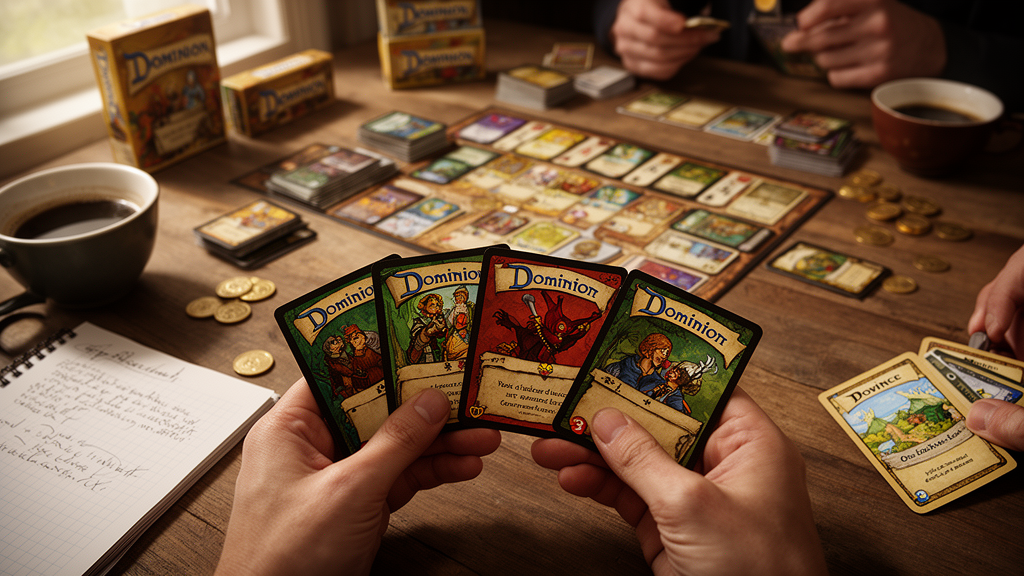
You open your mailbox, pull out a new game, and realize you have to build a deck before you can play it. That moment, the shuffle, the card draw, the slow realization that your hand is your entire strategy, is the exact moment deck building was born. Dominion didn’t just introduce a mechanic; it created a genre. Before 2008, you bought a game and played it. After Dominion, you bought a game and built the tools to play it.
The distinction matters more than the marketing copy admits. Dominion’s core loop, buy cards, build a deck, repeat, is not a minor variation on existing games. It is a structural shift that reorganized the entire hobby. Before Dominion, deck building meant drafting a pre-built deck for a single session (Magic: The Gathering) or managing a hand of cards that never changed (Bridge, Poker). Dominion asked players to construct their deck turn by turn, from a shared pool, with no guarantee that the cards they wanted would be available. That uncertainty is the engine of the genre, and it is also the source of every common failure mode on the first play.
Players who treat Dominion as a card game with extra steps lose consistently. Players who treat it as a resource-management game with a card-draw phase win. The difference is subtle but decisive. Dominion is not about collecting cards. It is about managing the velocity of your deck’s engine, and understanding that every card you buy is a trade-off between immediate power and long-term consistency.
The opening moves of Dominion reveal this tension immediately. On turn one, you buy a Copper. On turn two, you buy another Copper. On turn three, you buy a Silver. This is not a mistake; it is the necessary friction of building an engine. Every player goes through this phase, and every player wonders why their hand feels weak. The answer is that Dominion rewards patience. The cards you buy early are not meant to win you the game. They are meant to be fuel for the engine you are building.
Consider the most common failure mode: buying too many Victory points too early. A player sees a Province card, thinks “that’s worth 6 points,” and buys it on turn five. They feel smart. They are wrong. A Province in your deck slows your draw cycle, and a slow draw cycle means you miss turns where you could have bought better cards. The math is unforgiving. A deck with too many Victory cards averages fewer action cards per turn, which means fewer cards bought, which means fewer engine pieces, which means a slower deck. It is a feedback loop that punishes greed.
The solution is not to avoid Victory cards entirely. It is to time them. Buy enough engine pieces to draw your entire deck in one turn, then buy Victory. This is the Dominion rhythm: build, then score. Players who understand this rhythm stop thinking about points and start thinking about turns. They stop asking “what card should I buy?” and start asking “what card will make my next turn better?” That shift in thinking is the difference between a player who wins by luck and a player who wins by design.
Deck building as a mechanic solves a specific design problem: player agency in a shared pool. Before Dominion, most card games gave you a fixed hand and asked you to play it. Dominion gave you a blank slate and asked you to build the hand. That is a profound difference. It means every game is unique, not because of random card draws, but because of the choices you make about what to build. Two players can start with the exact same cards and end up with completely different strategies, simply because one prioritized action cards and the other prioritized economy.
This is why Dominion spawned an entire genre. After Dominion, designers asked: what if we applied this mechanic to other systems? What if you built a deck in a worker-placement game? What if you built a deck in a legacy campaign? What if you built a deck in a two-player game? The answer, repeatedly, is that it works. Dominion proved that deck building is not a gimmick. It is a fundamental design tool, and it is still the best tool for creating replayability without random setup.
Players who want to improve at Dominion should focus on one thing: deck velocity. Measure how many cards you draw per turn. If it is fewer than five, you are building too slowly. If it is more than eight, you are overbuilding and missing scoring opportunities. The sweet spot is usually between five and seven cards per turn, depending on the board state. This is not a hard rule. It is a heuristic. Use it to calibrate your buys, and you will stop guessing and start playing.