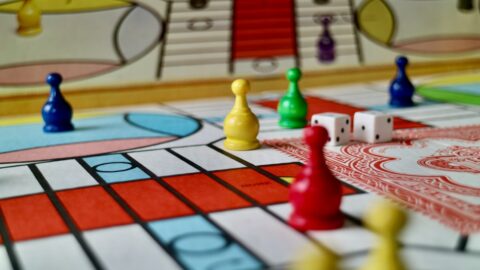
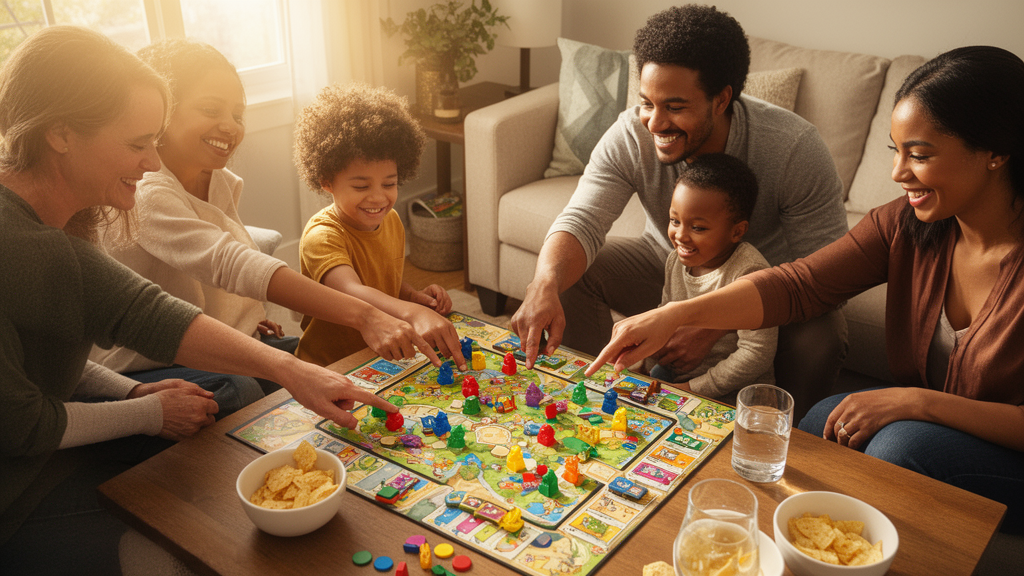
Family board games are not about winning. They are about shared failure. This is the single most misunderstood mechanic in modern hobby design, and it is the reason why so many families abandon the hobby after the first few months. You sit down with your spouse and your kids, pull out a box that promises “fun for all ages,” and within twenty minutes you are arguing about rules, someone is crying because they lost, and the dog is eating the cards. The game failed not because the components were cheap or the theme was bad. It failed because the game was designed to create winners and losers, and families are terrible at losing together.
The design community has known this for decades, but the marketing departments at the big publishers keep ignoring it. They sell family games as lightweight strategy competitions. They put them in the same aisle as the heavy eurogames and tell you to “play smart.” This is a lie. If you approach a family game like a competitive strategy game, you will lose the family. The secret to family gaming is not finding the perfect game. It is understanding that the primary goal of the game is to generate a shared emotional experience, and that winning is often the wrong move.
The Zero-Sum Trap
Most board games are built on a zero-sum framework. One person wins, everyone else loses. This works perfectly for two players who want to test their mettle against each other. It works for competitive tournaments. It does not work for a family with a seven-year-old and a thirty-five-year-old who just wants to relax after work. When you introduce a competitive victory condition to a mixed-age group, you immediately create a hierarchy. The adults dominate. The children suffer. The game becomes a reminder of the children’s incompetence rather than a shared activity.
Consider a standard game like Catan. It is marketed as a family game. It has cute wooden houses and a bright color palette. But at its core, it is a ruthless engine-building competition. If you play Catan with a group that includes a child who cannot yet calculate probability, that child will lose every single time. The adults will trade efficiently. They will block the child’s roads. They will hoard the resources. The child will sit there, powerless, watching their dream village get strangled by their parents’ superior strategic foresight. This is not fun. This is humiliation disguised as play.
The zero-sum trap is not limited to children. It affects adults, too. When a game has a single winner, the other players are forced into a role they rarely enjoy: the role of the obstacle. They must actively try to stop the winner from winning. In a competitive setting, this is the point. In a family setting, this is the poison. It turns your spouse into your enemy and your child into a defeated victim. The game stops being about the shared experience and starts being about who can inflict the most pain on the others.
The Cooperative Solution
The solution to the zero-sum trap is simple, yet publishers rarely market it correctly: cooperative games. In a cooperative game, all players share a single victory condition and a single defeat condition. You either win together, or you lose together. This fundamentally changes the dynamic at the table. It transforms your spouse from an obstacle into an ally. It turns your child from a defeated victim into a crucial team member.
Take Pandemic, released in 2008 by Z-Man Games. It is the gold standard for cooperative family gaming. The players are disease-fighting specialists trying to cure four diseases before they spread out of control. There is no “beating” your opponent. There is only the board, the cards, and the ticking clock. If you play Pandemic with a family, the seven-year-old is just as capable of contributing to the win as the thirty-five-year-old. They might not understand the complex card-trading mechanics, but they can spot a city on fire and react to it. They can feel the urgency. They can feel the triumph when the final cure is discovered.
This shared struggle creates a bond that competitive games simply cannot replicate. When you win Pandemic, the victory belongs to everyone. When you lose, the failure belongs to everyone. There is no one to blame but the game itself. This removes the social friction that kills family game nights. It allows the adults to guide the strategy without crushing the child’s spirit. It allows the child to feel powerful and essential. It turns the game into a shared narrative rather than a series of isolated transactions.
Cooperative games are not just for families. They are for anyone who wants to play games with people they love without the risk of ruining the relationship. They are the only genre that truly honors the word “family” in “family game.” They require communication, compromise, and collective problem-solving. They teach your children how to work together, how to manage frustration, and how to celebrate shared success. These are life skills that no competitive game can teach.
The Myth of the “Fair” Competition
Some families argue that competitive games are fine because they “teach kids how to lose.” This is a dangerous myth. There is a massive difference between losing a game and losing a game against someone who is actively trying to crush you while you are still learning the rules. Teaching a child to lose gracefully is important. But teaching them to lose gracefully against their parents, who have a decade of gaming experience and a superior prefrontal cortex, is not teaching. It is conditioning.
When you play a competitive game with a child, you are not creating a fair contest. You are creating a masterclass in power dynamics. The adult holds all the cards. The adult controls the pace. The adult decides when the game is over. The child has no agency. This is not how you build a love of games. This is how you build resentment. The child learns that games are stressful, that they are not good enough, and that they should just let the adults handle it next time. This is why so many kids grow up to hate board games. They were never taught how to play them. They were taught how to lose to them.
The alternative is to play games that are designed to be fair. Not fair in the sense that everyone has the exact same resources, but fair in the sense that everyone has a chance to contribute to the outcome. Games like Forbidden Island or Forbidden Desert offer this balance. They are easier than Pandemic, but they retain the cooperative core. They allow the child to make meaningful decisions that affect the group’s success. They allow the child to feel like a hero, not a hindrance. This is the key to family gaming: making the child feel like a hero.
Asymmetric Balance and the Family Sweet Spot
The best family games use asymmetric balance. This means that each player has different abilities, different resources, and different ways to win. This is crucial for mixed-age groups. If everyone has the exact same tools, the game becomes a test of pure calculation, which favors the adults. If everyone has different tools, the game becomes a test of synergy, which favors the group.
Look at Forbidden Island. One player is the Pilot, who can move between any two islands. Another player is the Archaeologist, who can dig up treasures from any location. A third player might be the Explorer, who can move twice per turn. These abilities are not “better” or “worse.” They are different. The Pilot is useless if they cannot reach the treasures. The Archaeologist is useless if they cannot move. The group must work together to combine their unique abilities to achieve the shared goal. This is asymmetric balance in action.
This design philosophy is what makes games like Forbidden Island so effective for families. It allows the child to pick a role that feels powerful and fun. It allows the adult to pick a role that supports the group. It creates a natural division of labor that mirrors real-life family dynamics. Everyone has a job. Everyone is needed. Everyone wins together.
Asymmetric balance is not just for cooperative games. Some competitive games use it to level the playing field. 7 Wonders Duel is a two-player game that uses asymmetric civilizations. One player builds military, the other builds science. Neither can win without the other. This forces interaction and prevents the game from becoming a solo puzzle. It is a brilliant design that proves competition can be cooperative in spirit, even if it is not cooperative in mechanics.
When Winning Is the Wrong Move
There is a final, counterintuitive lesson to learn about family gaming: sometimes, the best strategy is to lose. This sounds absurd, but it is true. In a family setting, winning too hard can be just as damaging as losing too hard. If you crush your child’s score, they will quit. If you crush your spouse’s score, they will resent you. The goal is not to win. The goal is to keep the game going.
This requires a level of self-awareness and emotional intelligence that most gamers never develop. It requires you to hold back your full potential. It requires you to make suboptimal moves. It requires you to prioritize the fun of the group over the victory condition. This is not “throwing.” This is “playing the table.” It is a skill that separates good gamers from great ones.
Consider a game like King of Tokyo. It is a dice-rolling game with a simple victory condition: be the first to reach 20 victory points. But if you play it competitively, it becomes a bloodbath. The strongest players will eliminate the weakest players in the first round. The game will end in twenty minutes, and the losers will be bored and angry. But if you play it cooperatively, it becomes a hilarious, chaotic mess. You can choose to help your child win. You can choose to let your spouse steal the last point. You can choose to make the game last longer by sharing the victory points. This is the art of family gaming.
The ability to win or lose gracefully is the hallmark of a mature gamer. It is the ability to read the room and adjust your playstyle accordingly. It is the ability to prioritize relationships over rankings. It is the ability to understand that the game is a tool for connection, not a weapon for domination. This is the lesson that every family gamer must learn.
The Legacy of Shared Failure
The future of family gaming lies in cooperative design. As the hobby matures, we are seeing a shift away from pure competition toward shared experiences. Games like Pandemic Legacy: Season 1 and Root: The Underground River are pushing the boundaries of what family games can be. They are complex, they are deep, and they are cooperative. They prove that family games do not have to be simple to be fun. They prove that family games can be challenging without being cruel.
These games are not just about playing together. They are about growing together. They create memories that last long after the boxes are put away. They create stories that the family will tell for years. They create a sense of shared history that no competitive game can match. This is the true value of family gaming. It is about the family.
If you want to build a love of games in your children, start with cooperative games. Start with games that make them feel like heroes. Do not start with games that teach them how to lose. Do not start with games that turn your family into enemies.
They are about the struggle, the triumph, the laughter, and the tears. They are about the moments that bind a family together. They are about the games that you will remember long after the pieces are packed away. Play them well. Play them together. And above all, play them for the love of the game, not the love of winning.