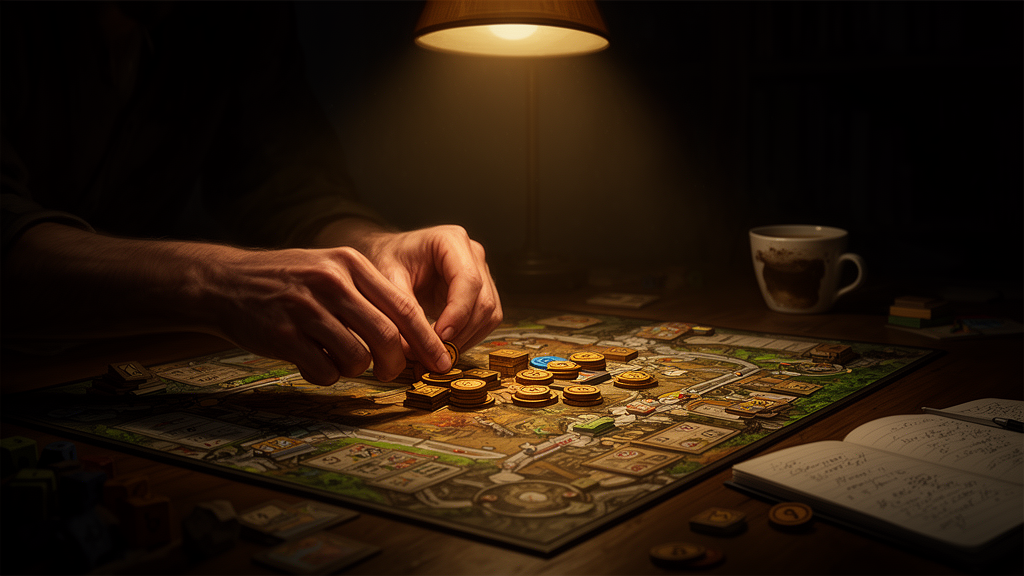
You bought a solo board game because you wanted to play something on a Tuesday night when your friends were busy. Instead, you are staring at a board full of tokens, a deck of cards with instructions that seem to contradict each other, and a scoring track that keeps moving. You are trying to beat the board. The board is not trying to lose to you. The board is trying to make you play a different game than the one you brought to the table.
Solo play is no longer a bolted-on afterthought in modern board gaming. It is one of the medium’s defining mechanisms. University research of over 104,000 titles confirms that solo play has moved from the margins to the center of the hobby. Yet most players approach solo games with the same mindset they use for multiplayer games: find the optimal sequence, optimize your engine, and crush the AI. That approach fails. Solo games are not about beating the board. They are about playing a specific type of game that the board forces on you, and winning requires understanding what that game actually is.
The AI Is Not an Opponent
Multiplayer games are social contracts disguised as rule systems. You negotiate, you bluff, you form temporary alliances, you sacrifice a turn to save a friend, you punish someone who broke the unspoken rules of the table. Solo games remove all of that. There is no one to blame when your plan fails. There is no one to negotiate with when the board presents an unexpected crisis. There is only you and a system that generates difficulty through randomness and deterministic rules.
Consider Ark Nova, which introduced a solo mode that most players treat as a puzzle to be solved. The solo mode generates a scenario deck that dictates the animals available, the habitats you can build, and the scoring targets. Players who approach it as a puzzle try to memorize the scenario deck, optimize their opening moves, and execute the perfect sequence. They fail because the scenario deck is not a puzzle. It is a randomizer that forces adaptation. The winning strategy is not to beat the scenario deck. It is to build a flexible engine that can handle whatever the deck throws at you.
Or take Wingspan, where the solo mode uses a deck of cards that represent a single opponent. Players who treat that deck as an opponent try to outplay it, to find the sequence that beats the card they drew. They fail because the solo deck is not trying to beat them. It is trying to create a specific game state. The winning strategy is to build an engine that works regardless of what the deck produces.
This distinction matters because it changes how you approach every solo game. When you treat the board as an opponent, you play optimally. When you treat the board as a collaborator in a different game, you play adaptively. Optimal play fails when the board presents a scenario you did not prepare for. Adaptive play survives because it is built to handle uncertainty.
The Three Types of Solo Games
Solo games fall into three distinct categories, and each requires a different mindset. Most players try to play all three with the same approach, and that is why they struggle.
Puzzle games present a fixed scenario with a single correct solution. On Mars is a puzzle game. You are given a specific set of objectives, a specific set of resources, and a specific set of constraints. Your job is to find the sequence that completes the objectives. Puzzle games reward memorization, optimization, and pattern recognition. If you enjoy Sudoku, you will enjoy puzzle games.
Adaptation games present a random scenario that changes every play. Ark Nova solo mode is an adaptation game. You are given a random scenario deck that dictates what is available and what you need to score. Your job is to build an engine that can handle whatever the deck produces. Adaptation games reward flexibility, scenario reading, and engine building. If you enjoy chess, you will enjoy adaptation games.
Progression games present a campaign where the board changes permanently over multiple plays. Pandemic Legacy: Season 1 is a progression game. Every play changes the board, adds stickers, tears pages, and alters the rules. Your job is to survive the campaign and understand how the changes interact. Progression games reward long-term planning, emotional investment, and acceptance of loss. If you enjoy a good novel, you will enjoy progression games.
Most players try to play adaptation games like puzzle games. They memorize the scenario deck, optimize the opening moves, and fail when the board presents a scenario they did not prepare for. They try to play progression games like puzzle games. They look for the optimal sequence, ignore the emotional weight of the stickers, and fail when the board forces them to sacrifice something they care about.
How to Play Solo Games Correctly
Understanding the type of solo game you are playing changes everything. Here is how to approach each type.
For puzzle games: Focus on memorization. Learn the scenario. Learn the constraints. Learn the optimal sequence. Practice the same scenario until you can complete it without looking at the rules. Puzzle games are about mastery. If you cannot solve a puzzle game on your third attempt, you are not trying hard enough.
For adaptation games: Focus on flexibility. Build engines that can handle multiple scenarios. Learn to read the scenario deck and adjust your strategy accordingly. Accept that you will fail sometimes. Failure is not a sign that you are playing wrong. It is a sign that the board is doing its job. Adaptation games are about resilience. If you win every time, the game is too easy.
For progression games: Focus on the story. The stickers are not obstacles. They are the story. The torn pages are not damage. They are the narrative. The altered rules are not chaos. They are the evolution of the game. Progression games are about emotional investment. If you are not crying when a character dies, you are not playing it right.
When Solo Games Break Down
Solo games fail when you try to play them like multiplayer games. You cannot negotiate with a deck of cards. You cannot blame a randomizer for bad luck. You cannot form an alliance with a scoring track. When you try to play a solo game like a multiplayer game, you will fail. That is not a reflection on you. It is a reflection on the mismatch between your mindset and the game’s design.
Solo games also fail when you treat them as puzzles that have a single solution. They do not. They are designed to be replayed, to offer new challenges, to evolve. If you treat a solo game as a puzzle, you will solve it once and never play it again. That is not a failure of the game. It is a failure of your expectations.
Finally, solo games fail when you ignore the emotional weight of progression mechanics. Stickers are not decorations. They are the story. Torn pages are not damage. They are the narrative. Altered rules are not chaos. They are the evolution. If you treat a progression game as a puzzle, you will miss the point entirely. That is not a failure of the game. It is a failure of your engagement.
What This Changes About How You Play
Understanding that solo games are not about beating the board changes how you approach every solo game. You stop trying to optimize. You start trying to adapt. You stop looking for the perfect sequence. You start building flexible engines. You stop treating the board as an opponent. You start treating it as a collaborator in a different game.
This mindset shift is what separates players who struggle with solo games from players who love them. It is not about skill. It is about understanding what the game is asking you to do. When you understand that, solo games stop being frustrating and start being rewarding. When you understand that, solo games stop being a compromise and start being a primary way to play.
Solo play is no longer a bolted-on afterthought. It is one of the medium’s defining mechanisms. The research of 104,000 titles confirms it. The growing number of solo-only games confirms it. The growing number of players who prefer solo games confirms it. But none of that matters if you approach solo games with the same mindset you use for multiplayer games. Solo games are not about beating the board. They are about playing a different game than the one you brought to the table. When you understand that, you will never play solo games the same way again.
Frequently Asked Questions
What is the best solo board game for beginners? Start with On Mars. It is a puzzle game with a fixed scenario, clear objectives, and a single correct solution. If you enjoy Sudoku, you will enjoy On Mars.
How do I know if a solo game is a puzzle game or an adaptation game? Look at the scenario generation. If the scenario is fixed and does not change, it is a puzzle game. If the scenario is random and changes every play, it is an adaptation game. Ark Nova solo mode is an adaptation game. On Mars is a puzzle game.
Why do I fail at solo games even though I win multiplayer games? Because you are trying to play a solo game like a multiplayer game. You cannot negotiate with a deck of cards. You cannot blame a randomizer for bad luck. You cannot form an alliance with a scoring track. Solo games require a different mindset.
Is solo play really a major trend in board gaming? Yes. University research of over 104,000 titles confirms that solo play has moved from the margins to the center of the hobby. The number of solo-only games released every year continues to grow. The number of players who prefer solo games continues to grow. Solo play is no longer a niche. It is a primary way to play.
What should I do when a solo game feels too hard? If it is a puzzle game, practice the same scenario until you can solve it. If it is an adaptation game, accept that failure is part of the game. If it is a progression game, focus on the story, not the score. Solo games are not about winning. They are about playing the game they are asking you to play.