
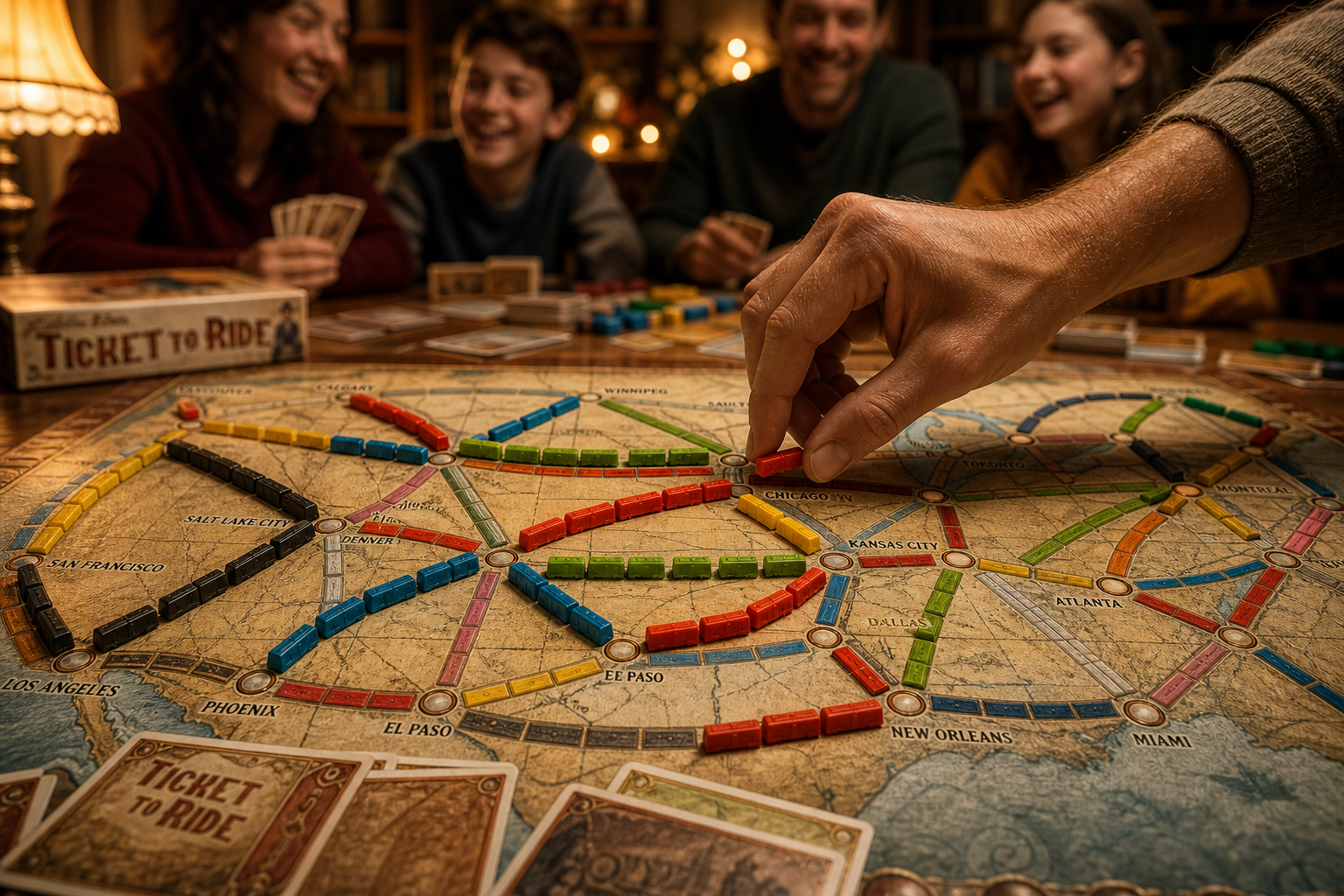
In the autumn of 2004, a game about trains won the Spiel des Jahres, the German board game industry’s most coveted prize, and almost nobody outside Europe noticed. The game was Ticket to Ride, designed by Alan R. Moon and published by Days of Wonder. Within two years it had sold over a million copies. Within a decade, it had become the single most important gateway game of the modern hobby era, the title that sits on the shelf between Monopoly and Catan and quietly convinces families there’s a whole world past both. That journey from Spiel winner to cultural staple happened for one reason most people miss: Ticket to Ride is not trying to be fun. It’s trying to be comfortable, and that comfort is a deliberate, sophisticated design choice that most family games still get wrong.
What Makes a Family Game Actually Work
Ask a room of hobby gamers what makes a good family game and you’ll get answers about theme, component quality, play time, and accessibility. All of those matter. But the question most designers don’t ask first is: what does a ten-year-old feel like when they’re losing?
That question sounds soft. It isn’t. At a family table, one player is almost always significantly younger, less experienced, or more emotionally invested in the outcome than the others. When that player hits a wall, when they realize they’re behind with no path back, the whole table suffers. The twelve-year-old goes quiet. The six-year-old starts crying. The adults spend the last twenty minutes managing the room instead of playing the game. The session ends, and nobody wants to get that one out again.
Ticket to Ride handles this problem with a design feature so embedded you barely notice it: the game never tells you how far behind you are until it’s over.
Hidden Score Compression and Why It Feels Like Magic
Most of the scoring in Ticket to Ride comes from two sources: the points printed on the board for each completed route, and the bonus (or penalty) from your secret destination tickets. Route points are visible to everyone, you lay your plastic trains, you take your points, the score tracker moves. But the destination tickets? Those stay hidden until the final reveal.
This is the design doing something elegant. A player who is behind on the route-scoring track might be sitting on completed destination tickets worth 45 points. A player who looks dominant might have ambitious, uncompleted tickets that will subtract 30 points at the end. Nobody knows. The gap between “this is going badly for me” and “I might actually be winning” stays genuinely uncertain until the last train is placed.
Compare this to a game like Catan (Klaus Teuber, Mayfair Games, 1995), where every victory point is public and every player knows the exact gap at every moment. Catan is a brilliant game, but it produces a specific kind of family-table suffering: the runaway leader who everyone can see pulling away, and the trailing player who watches the distance grow for forty-five minutes. Catan compensates for this with its trading and blocking mechanics, which are wonderful when experienced players use them, and completely opaque to a first-timer who just wants to build roads.
Ticket to Ride never asks you to negotiate, block, or read the table politically. It asks you to plan a route and execute it. That’s a manageable cognitive ask for a wide age range, and the hidden-ticket scoring means the emotional stakes stay compressed until the very end.
Ticket to Ride as a Family Game: The Honest Case
Here is where the game’s reputation gets a little complicated. Ticket to Ride is often sold as a game for ages 8 and up, and that’s roughly right, but what it actually plays like depends heavily on which version you bring to the table and how many players you have.
The base game (the USA map, the one with the steam-locomotive box) plays best at three or four players. At two, the board is so open that the blocking tension disappears entirely and the game becomes a parallel solitaire exercise. At five, the board tightens dramatically and route competition turns cutthroat in ways that can blindside younger players who built a strategy around a specific path only to find it claimed on turn two.
For families with children under ten, Ticket to Ride: First Journey (Days of Wonder, 2016) is the sharper recommendation. It strips the destination-ticket complexity down to a simpler “complete six tickets to win” structure, runs in about twenty-five minutes, and introduces the core mechanics without the endgame scoring math. Think of it as the same design DNA with a shorter runway: it teaches the game, not just the theme.
For families who’ve outgrown the base game, Ticket to Ride: Europe (Days of Wonder, 2005) adds tunnels, ferries, and train stations, mechanisms that create more decision points without requiring a new game to learn. Tunnels introduce a small luck element (draw three cards, count color matches, pay the difference or abandon the route) that levels the playing field between a careful planner and a spontaneous eight-year-old. It’s the best follow-up once your group knows what they’re doing.
The One Strategic Insight Most Families Miss
Play Ticket to Ride with a family group ten times and you’ll see the same losing pattern repeat: someone grabs routes aggressively early, runs out of trains fast, and triggers the end of the game before slower players complete their tickets. That player usually doesn’t win. The winner is almost always the person who managed their train supply.
You start with 45 trains (in the USA base game). Each route you claim costs trains. When any player places their second-to-last segment, down to two or three trains remaining, the final round is triggered, and every other player gets one more turn. The game’s design puts a hard clock on ambition: the longer you can keep trains in reserve while still scoring, the more turns you give yourself to complete expensive, high-value destination tickets.
The non-obvious corollary: drawing destination tickets mid-game is often correct. Most families treat the starting tickets as the whole plan and never draw more. Experienced players draw additional tickets once they’ve secured a geographic spine, a chain of routes running coast-to-coast or corner-to-corner, because additional tickets that connect to your existing network are nearly free points. A ticket worth 20 points that you complete with one additional route you were building anyway is extraordinary value. But a ticket worth 20 points that requires you to reroute half your network is a trap.
The self-test for this: look at your claimed routes mid-game and ask whether they form a connected chain or isolated islands. Islands are danger. A connected chain means every new route you claim extends what’s already working. That’s when to draw more tickets. That’s when the endgame math starts working in your favor.
Where Ticket to Ride Stops Being Enough
Every gateway game has an expiration date for its audience. Ticket to Ride’s is real and worth naming honestly.
Once a group has played fifteen or twenty times, the game’s depth ceiling becomes visible. The route-planning decisions stop feeling novel, the destination tickets start to feel repetitive, and the experience flattens into something comfortable but not stimulating. That’s not a flaw, it’s exactly the right lifespan for a gateway title. The game’s job is to make your group comfortable with hidden goals, simultaneous planning, and a score that isn’t resolved until the final moment. Once those skills are natural, you’re ready for something with more complexity.
From Ticket to Ride, the natural next steps for a family group depend on what they liked. If the route-building and network feel was the appeal, Wingspan (Elizabeth Hargrave, Stonemaier Games, 2019) offers a richer tableau-building experience with a similarly gentle competitive structure. If the hidden goals and final-reveal tension was the hook, Sushi Go Party! (Phil Walker-Harding, Gamewright, 2016) delivers that in twenty minutes with a lighter touch. If a longer, more ambitious experience feels right, Pandemic (Matt Leacock, Z-Man Games, 2008) pivots the whole group to cooperative play, which eliminates the trailing-player problem entirely by design.
The point is that Ticket to Ride doesn’t need to be the destination. It was never trying to be. Alan R. Moon built a machine that teaches families how to sit with uncertainty, plan across multiple turns, and stay engaged even when things look grim. Those are exactly the skills every harder game you’ll ever want to play requires.
Why the Train Theme Earns Its Keep
One last thing worth saying, because theme is often dismissed as cosmetic in design discussions: the train theme in Ticket to Ride is load-bearing, not decoration.
Trains running along fixed routes is one of the most intuitive spatial models in everyday life. Children understand that a train must stay on the track, that two trains can’t occupy the same segment, and that routes connect cities to each other. The physical metaphor carries the rules. When a player claims a route by placing colored train cars on a path, the action explains itself. Nobody needs to ask why blue cards let you claim a blue route, or why longer routes score more than shorter ones. The geography does that work, and the plastic trains on the board make the competition visible in a way that abstract point-tracking never quite manages.
That’s the design lesson Ticket to Ride has been teaching for two decades, and most family games still haven’t learned it: the best mechanisms and the best theme say the same thing at the same time. When they do, even a ten-year-old playing their first board game can feel the logic of what they’re doing. Days of Wonder’s official Ticket to Ride page lists the full family of maps and editions if you want to see how far the design has stretched since 2004. It’s a long way from a single USA board to fifty-plus maps worldwide, and every one of them runs on the same elegant engine Moon built for a German award ceremony nobody outside Europe was watching.
The Spiel des Jahres jury saw something that autumn. It took the rest of the world a few years to catch up.