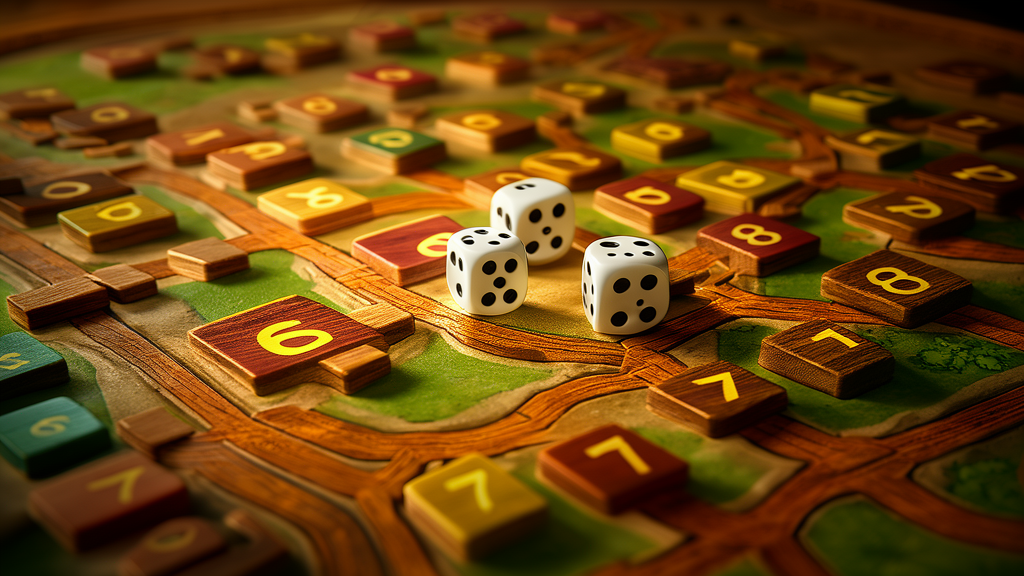
Rolling a 7 happens 14% of the time. Rolling a 6 or 8 happens 13.9% each. Rolling a 2 or 12 happens 2.8% each. That is not random. That is a bell curve. And Catan is a game built entirely on the assumption that you will see 6, 7, and 8 more than half the game.
Catan (formerly The Settlers of Catan) is not a building game. It is a probability game disguised as a building game. The wooden houses and roads are just the UI. The real game is the math of the 2d6 distribution, the robber’s disruption curve, and the probability of drawing the right resource at the right time. Understanding this changes how you play, how you evaluate the board, and who you trade with. It also explains why the game feels so different at 3 players versus 4 or 5.
The core insight is simple: Catan is a game about managing variance. Players who ignore the bell curve are essentially betting against the house, and the house always wins in the long run.
Most new players learn Catan by trying to build roads and cities. They look at the board, see a resource gap, and think, “I need more ore.” They place a settlement near a 3-ore hex, hoping the dice will be kind. This is the fundamental error. The dice are not kind. The dice are mathematical. And the game rewards players who understand that.
The 2d6 Bell Curve Is the Game’s Real Board
When you roll two six-sided dice, the possible sums range from 2 to 12. But they are not equally likely. There is only one way to roll a 2 (1+1), but six ways to roll a 7 (1+6, 2+5, 3+4, 4+3, 5+2, 6+1). This is the bell curve. It is the single most important concept in Catan, and it is the reason the game works.
Here is the distribution, broken down by probability:
- 2 and 12: 2.8% each (1 way out of 36)
- 3 and 11: 5.6% each (2 ways)
- 4 and 10: 8.3% each (3 ways)
- 5 and 9: 10.2% each (4 ways)
- 6 and 8: 13.9% each (5 ways)
- 7: 14% (6 ways)
Notice that 6, 7, and 8 together account for 41.8% of all rolls. That is nearly half the game. If your settlement is on a 6 or 8, you will generate resources roughly once every 7 rolls. If your settlement is on a 2 or 12, you will generate resources roughly once every 36 rolls. That is a 5x difference in output, purely from placement.
This is why experienced Catan players prioritize 6, 7, and 8 over everything else. It is not a preference. It is mathematics. The board is not a puzzle of resource matching. It is a probability map. Every hex is a weighted random variable. Your job is to maximize the expected value of your settlements.
Consider a board where you can place a settlement on either a 5 or a 9. Both are equally likely (10.2% each). But the 5 is slightly better because it is closer to the center of the distribution. The 9 is on the tail. If you have to choose, pick the 5. If you have to choose between a 5 and a 10, pick the 5. The further you are from 7, the worse your placement. This is not opinion. This is the 2d6 distribution.
The Robber Is a Variance Limiter, Not a Weapon
Most players treat the robber as an offensive tool. They move it to block an opponent’s 8 or 9, hoping to slow them down. This is a common mistake. The robber is not a weapon. It is a variance limiter. Its real function is to reduce the variance of the board, making the 6, 7, and 8 distribution even tighter.
When the robber sits on a 9, that hex’s probability drops from 10.2% to 0%. The probability mass does not disappear. It redistributes across the other numbers, slightly increasing the frequency of 6, 7, 8, and 5. This makes the board more predictable. It makes the game more about probability management and less about luck.
This is why experienced players place the robber on 9s and 10s, not 6s and 8s. Blocking a 6 or 8 hurts the player who benefits from it the most. Blocking a 9 or 10 hurts the player who is already on the tail of the distribution. The robber is a corrective mechanism. It pushes the board back toward the mean. Use it that way.
Consider a board where Player A has a settlement on a 9, and Player B has a settlement on a 6. If you move the robber to the 9, Player A’s output drops to zero. Player B’s output on the 6 remains unchanged. The gap between them widens. If you move the robber to the 6, Player B’s output drops, but Player A’s output on the 9 remains. The gap narrows. The robber is a leveling mechanism. Use it to level the board, not to punish the strong.
Trading Is a Probability Arbitrage
Most new players trade reactively. “I need wheat. I will trade for wheat.” This is backward. Trading is a probability arbitrage. You are buying probability at a discount. You are selling probability at a premium. The goal is to maximize the expected value of your trades.
Here is the framework: every resource has a different probability of being generated by the board. Wood and brick are the most common resources on a standard board. Ore and wheat are the rarest. If you have a settlement on a 5-wood, you are generating wood at a higher rate than most players. You should trade wood for ore or wheat, not the other way around. You are selling probability at a premium.
Consider a board where you have a settlement on a 5-wood and a 9-ore. You are generating wood frequently and ore rarely. If another player has a settlement on a 6-wheat, they are generating wheat frequently. You should trade wood for wheat. You are selling probability at a premium (wood) and buying probability at a discount (wheat). This is the core of Catan trading.
Most players trade one-for-one. This is inefficient. A player with a 5-wood should trade two wood for one wheat. The wheat is rarer. The wood is more common. The trade should reflect the probability difference. This is not a negotiation. This is a market. Price your resources by their probability of generation.
Consider a board where you have a 5-wood, a 9-ore, and a 6-wheat. You are generating wood frequently, ore rarely, and wheat frequently. Your most valuable resource is ore. Your least valuable resource is wood. Trade wood for ore. Trade wheat for ore. Do not trade ore for wood. You are selling probability at a premium and buying probability at a discount. This is the core of Catan probability management.
Expansion Is a Variance Play, Not a Growth Play
Most new players expand when they have the resources. They build a settlement, then another, then another. This is growth. It is not variance management. Expansion in Catan is a variance play. You are placing settlements to maximize the expected value of your future rolls. You are not building for growth. You are building for probability.
Consider a board where you have a settlement on a 5-wood and a 9-ore. You have 12 resources. You can build a settlement on a 6-wheat or a 10-wood. The 6-wheat is closer to the mean. The 10-wood is on the tail. You should build on the 6-wheat. You are maximizing expected value. You are not building for growth. You are building for probability.
This is why experienced Catan players expand along the 6-7-8 axis. They place settlements on 6, 7, and 8 hexes, even if it means skipping a 5 or a 9. They are not building for growth. They are building for probability. They are maximizing the expected value of their future rolls. This is the core of Catan expansion strategy.
Consider a board where you have a settlement on a 5-wood and a 9-ore. You have 12 resources. You can build a settlement on a 6-wheat or a 10-wood. The 6-wheat is closer to the mean. The 10-wood is on the tail. You should build on the 6-wheat. You are maximizing expected value. You are not building for growth. You are building for probability. This is the core of Catan expansion strategy.
When the Math Breaks Down
Probability is not destiny. The dice can roll 2 three times in a row. The robber can sit on your 6 for five turns. The board can be unbalanced. This is the variance. This is the luck. This is the game.
But understanding the math gives you a baseline. It gives you a framework for decision-making. It gives you a way to evaluate the board, to trade, to expand, and to play the robber. It does not guarantee victory. It increases your expected value. It makes you a better player.
The goal is not to eliminate luck. The goal is to manage it. The goal is to maximize your expected value. The goal is to play the probabilities, not the board. This is the hidden math of Catan. This is the reason it works. This is the reason it endures.